

Car Park Alternative Uses
An evidence-based approach to repurposing land assets
Built for any asset that should be doing more. A methodology to determine what sites like car parks should become, prove demand before capital is committed, and deliver the case to act.
Applied with TfL's Places for London. Relevant to any transport authority, local council or commercial landowner with assets that should be delivering more social and commercial value.


Car park land is one of the most underutilised asset classes in the UK. Most organisations know it. Few have a way to act on it.
↓ ~30% lower average occupancy in off-street car parks than pre-pandemic levels
↓ Fewer car trips as EV policy, low traffic neighbourhoods, and ULEZ-style schemes reduce car use by design
↓ Less commuting as remote and hybrid working has structurally reset parking demand
↓ Less high street footfall as online retail continues to pull shoppers from town centres and retail-adjacent car parks
THE CHALLENGE
How do you maximise the value of a car park and prove a new use will work?
Most organisations with underperforming car parks have ideas for what else they could do. Very few have tested those ideas against real market data, built site-specific evidence that a new use will work, or developed a case strong enough to get stakeholders onboard.
Without that, ideas stay as ideas. Sites stay idle.
OUR APPROACH
We provide a systematic, venture-building approach to turn intent into validated, delivery-ready propositions.
01
Data-Backed Design
We layer public and proprietary datasets to surface options that instinct and manual analysis miss. Geospatial data analysis, our own IP, and AI-powered frameworks identify alternative use options based on area profile and asset performance.
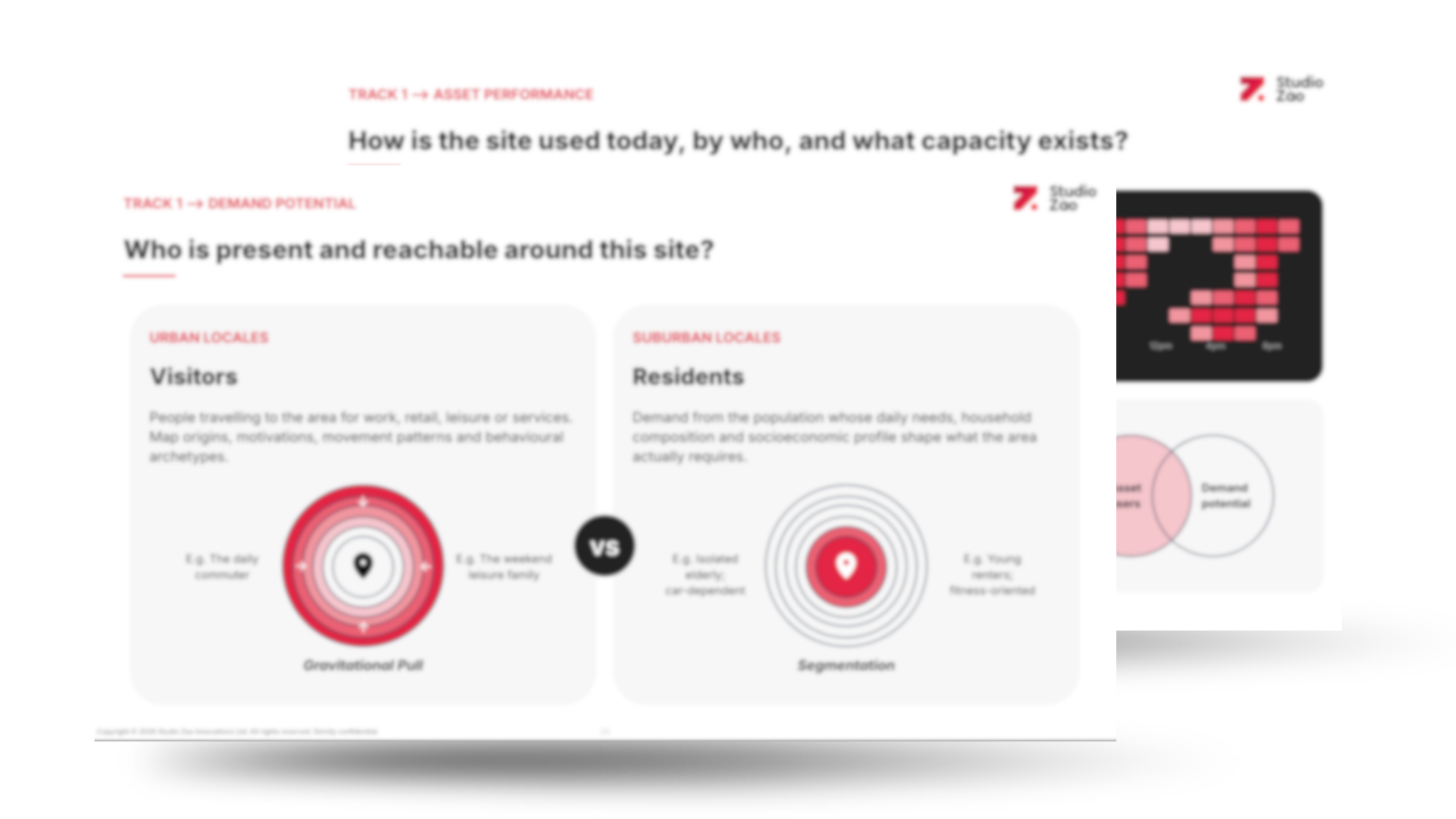
Demand Potential — Who is present and reachable around the site
Asset Performance — How the site is used today and what capacity exists
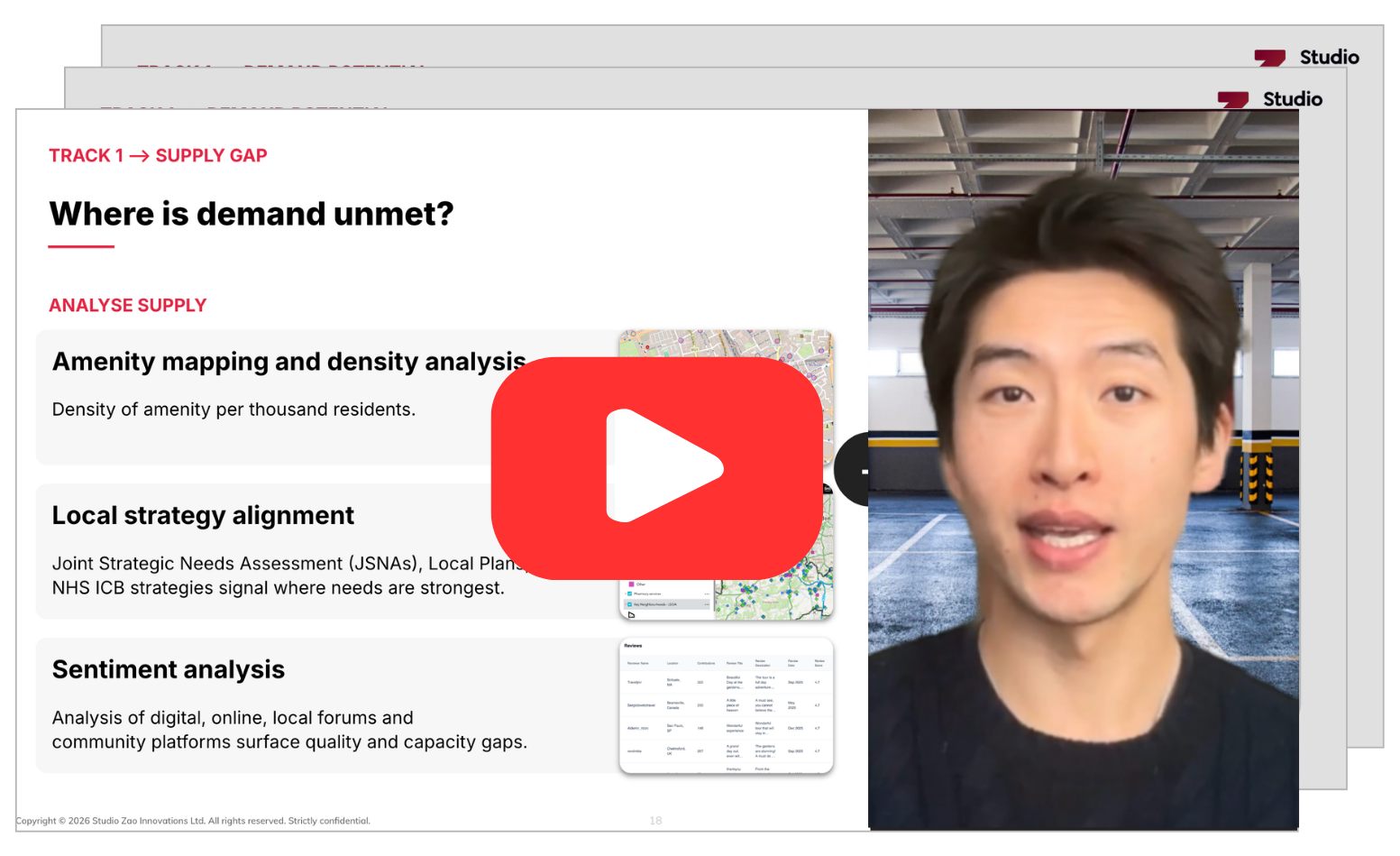
Supply Gap — Where local demand is unmet or underserved
02
Test and validate
We treat each potential use as a startup proposition. Hypothesis, test, evidence, iterate. We do not hand over a report. We go to the sites, validate with real people, source operators, and build commercial proof.
Customers (Desirable)
Will people actually use this?
→ What is this area missing?
→ Would you use this, and how often?
→ What would you be willing to pay?
Council/Stakeholders (Feasible)
Is it deliverable?
→ Does this align with local priorities?
→ Are there site-specific constraints?
→ Who should we be working with?
Supply/Operators (Viable)
Can it be supplied?
→ Is this site commercially viable?
→ Do demand profiles align?
→ What have you seen work and why?
How: Startup-style experiments that de-risk concepts. Focus groups, prototype-to-pilot testing, real customer feedback. Small-scale and designed to produce evidence for decisions.
03
Activate
Validated concepts become funded, partnered, and operational.
Business Case — Package demand evidence, feasibility sign-offs, and financial models into a case built for planning committees and investment sign-offs
Delivery Partners — Source and negotiate with operating partners. Define commercial models, lease structures, and what success requires at site level
Pilot-to-Scale — Move from validated concept to live activation with a clear implementation roadmap, funding secured, and stakeholders already aligned
Get the full case study pack.
✅ Webinar walkthrough of our methodology
✅ Interview with Places for London
✅ Beyond Parking Project case study (PDF)
✅ Access to upcoming private community and events on this topic
We will protect your personal information in accordance with our Privacy Statement.